Current Weather - Keene, NH
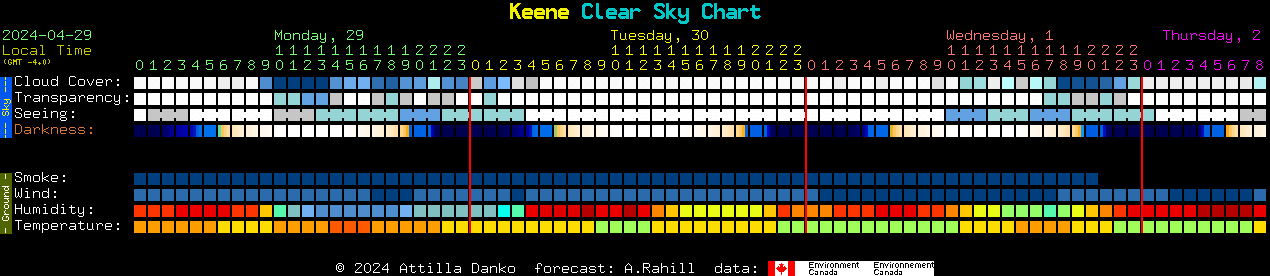
Clear Sky Chart

Keene, NH:

Click the image for a complete sky condition forecast.

Chart courtesy of ClearDarkSky.com

Sun and Moon
Click for Keene, New Hampshire Forecast
For a complete month-by-month
moon phase calendar, click here.
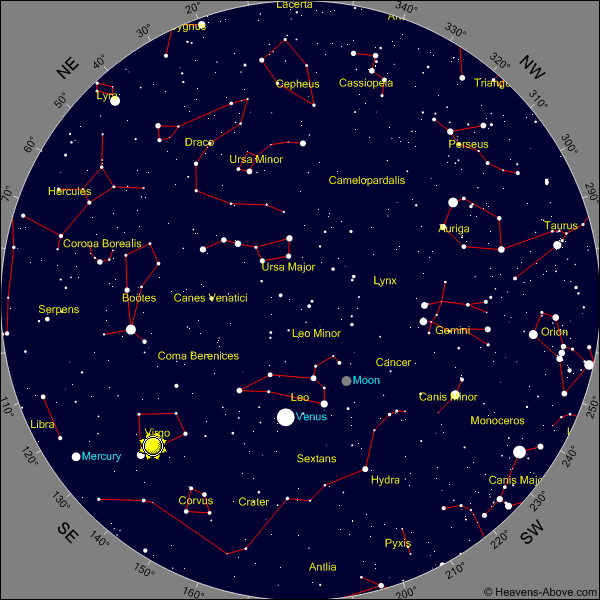
Tonight's Sky

Time

Keene, NH

UTC

Welcome - What We Do

The Keene Amateur Astronomers Club is a group of people whose goal is the enhancement of Amateur Astronomy by fellowship, sharing knowledge and enjoyment of the hobby. The KAA Club provides outreach programs when asked and holds monthly viewing sessions at our own observatory. Regular monthly club meetings are held at the Keene State college. Anyone interested is invited to attend.

Our membership is open to students, parents, beginners, backyard amateurs and also experienced professionals. And we provide opportunities for our members to grow in one of the greatest hobbies in this world or any other!

Founded in 1957, our club has a long and distinguished history. We are also members of the Astronomical League. And we actively participate in the annual Stellafane Convention which is consistently rated as one of America’s top Star Parties!

June 2013 Meeting

The June 2013 business meeting will take place on Friday the 21th at 7:00pm at the club's Sullivan Observatory. Observing, weather permitting, will occur following the meeting at the club's Observatory.

Observing will also take place Saturday the 15th beginning at 8:30pm at the club's Observatory, weather permitting.

All members and interested non-members are invited.

For directions, contact our Club Secretary, Bob Taylor, at 802.257.9358.


Exoplanets: Worlds Beyond Our Solar System

An extrasolar planet, or exoplanet, is a planet outside the Solar System. The search for exoplanets is one of the most exciting fields in astronomy and will perhaps one day answer the question of whether we are alone in the universe. Although searching for alien worlds dates back to ancient times the techniques needed to detect them have only recently been developed with the first exoplanet being discovered in 1992.

Starting in 1992 with the first discovery, astronomers have located, as of March 22, 2013, 861 such planets in 677 planetary systems around the Milky Way galaxy. Researchers believe they will find many more planets — a 2012 study estimated that each star of the 100 billion or so in the Milky Way galaxy hosts on average at least 1.6 planets. Astronomers at the Harvard-Smithsonian Center for Astrophysics (CfA) reported in January 2013, that "at least 17 billion" Earth-sized exoplanets are estimated to reside in the Milky Way Galaxy.

Exoplanets are very difficult to detect because they don't emit any light of their own and are completely obscured by their extremely bright parent stars - normal telescope observation techniques cannot be used. The five most common methods for finding extrasolar-planets are: Pulsar timing, Radial-velocity, Astrometry, Gravitational lensing, and Photometry.

For further information, check the NASA Astrophysics Focus Area: Planets Around Other Stars and the JPL website: PlanetQuest.


2013 - The Year of The Comets?

2013 may someday be known as "the year of the comets". If all goes well, we may see two of the brightest comets in many years, and possibly one of the brightest in history. Never the less, astronomers are being very cautious in their predictions because of past disappointments. There are always comets in the sky, but most are too far from the sun to develop large tails, and too far from Earth to be seen with the naked eye. Bright comets appear only every few years, so it is very rare for two comets to appear in a single year.

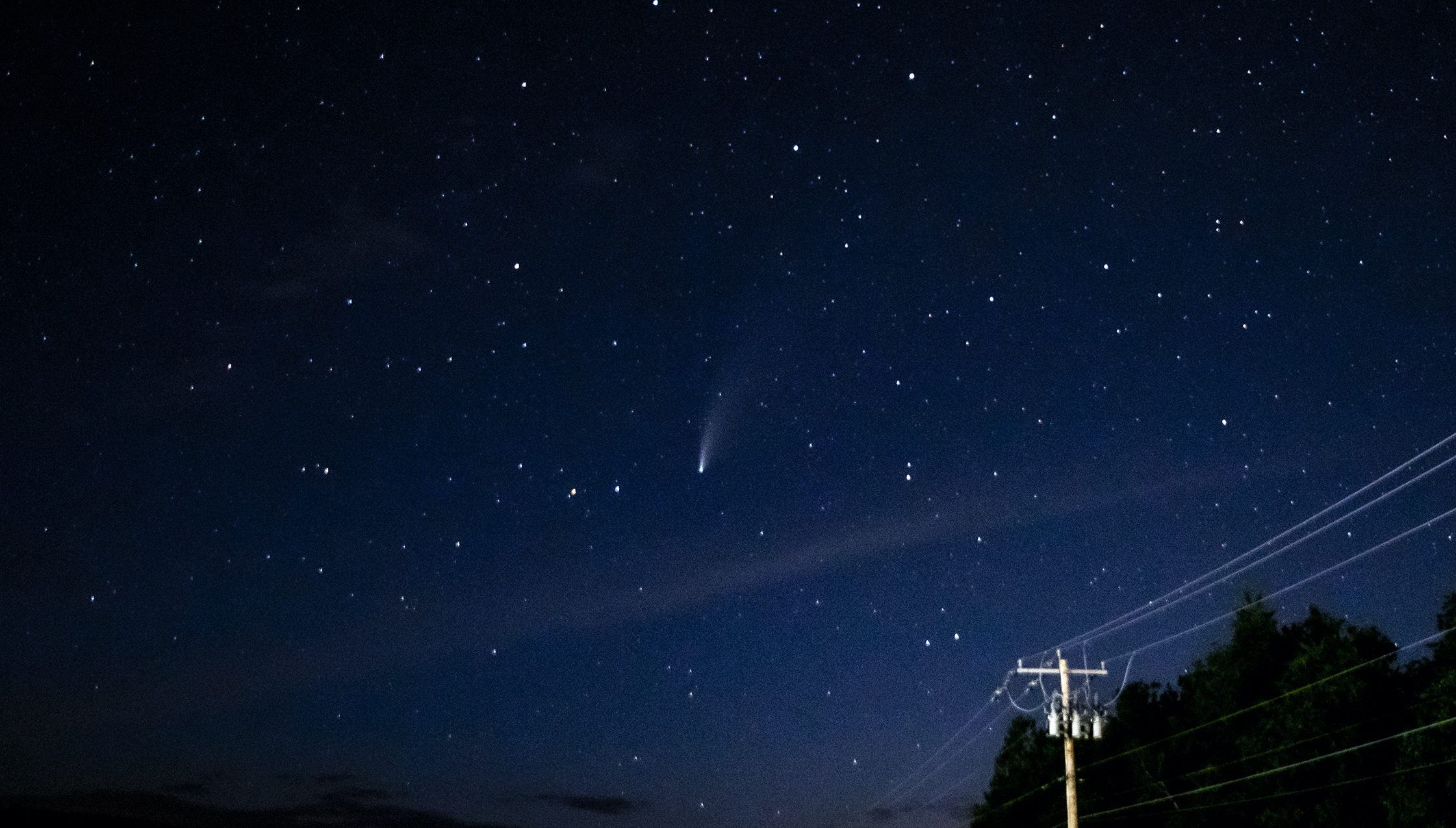
Comet C/2011 L4 [Pan-STARRS]
It was discovered by the Panoramic Survey Telescope and Rapid Response System, known by the acronym Pan-STARRS, in Hawaii on June 5-6, 2011.While visible here in Keene, NH,during March, the comet was able to be seen by the naked eye in East Hill, VT [Donna Monahan], Skeikampen, Norway, Stonehedge, and Queenstown, New Zeland. And finally, there is the image of the comet and M31 by Pavel near Syktyvkar, Russia. If you saw it, keep that memory.

Comet C/2012 S1 [ISON]
This comet was discovered on Sept. 21, 2012, through a telescope in Russia that is part of the International Scientific Optical Network, known as ISON. It should put on a spectacular show in the days immediately before and after the end of November. It is predicted to become brighter than the full moon and to be visible in the daytime sky.

Both comets have an eccentricity slightly greater than 1.0, making their orbits slightly hyperbolic, meaning that this may be the first time they will ever come close to the sun, and that they may never return. For more on what makes a comet's orbit periodic, parabolic, or hyperbolic, check out orbital eccentricity.


Coming Area Astronomical Gatherings

We are fortunate to have several astronomical conventions nearby this year. Check out the following and then your summer calendars:

Connecticut River Valley Astronomers Conjunction - July 12-13

This Conjunction has taken place annually since the '90s and is held at the Northfield Mountain Recreational and Environmental Center in Northfield, MA, on Friday, July 12th, and Saturday, the13th. Folks arrive on Friday for night for observing and Saturday is full with observing sessions, swap table, solar star party, and lectures. Accomodations are nearby with plenty of food on-site.


2013 Stellafane, VT, Convention - August 8-11

The 2013 Stellafane Convention will be held Thursday through Sunday August 8-11. The Stellafane Convention is a gathering of amateur telescope makers. The Convention was started in 1926 to give amateur telescope makers an opportunity to gather to show off their creations and teach each other telescope making and mirror-grinding techniques. All telescopes, commercial and homemade are welcome. There are also mirror-grinding and telescope-making demonstrations, technical lectures on telescope making and the presentation of awards for telescope design and craftsmanship. Vendor displays and the retail sale of commercial products are not permitted.

New England Fall Astronomy Festival [NEFAF] - September 13-14

This two-day Festival will occur September 13th and 14th . This year the keynote speaker will be award-winning author of Longitude and Galileo's Daughter, Dava Sobel. NEFAF 2013 promises an immersive weekend of astronomy-related activities and experiences for children, families, and people of all ages and expertise. Hosted by the UNH Physics Department and staffed, organized, and driven by members of the astronomical community from throughout New England, NEFAF 2013 offers a fun-filled event for the whole family that's not soon to be forgotten! Check it out on Facebook for the latest details.

The Spring Constellations

Spring began with the vernal equinox which occured on March 20th in the Northern Hemisphere and ends at the June solstice. This change heralds the rise of the spring constellations and we have to say goodbye to the stars of winter. The spring constellations are the 15 constellations that fall between the 12 hours and 18 hours Right Ascension. Here are several resources to help you in your viewing during the coming months.

The American Association of Amateur Astronomers provides a list of the 15 spring constellations and a detailed map of the sky. They also provide similar information for the other seasons.

StarrySkies.com also has a nice interactive map of the stars of spring.

For greater details on the sky's wonders, move your fingers over to the star website at the University of Illinois at Urbana Champain. Or check out the details of the constellations and their stars at the University of Wisconsin - Madison.

Are you looking to download a star chart or constellation map app for your smartphone or tablet computer? Here is an excellent article on available resources to guide you in your winter nighttime viewing. Some of these programs even allow you to hold your phone or tablet up to the night sky and see the exact position of the constellations. And, of course, trip over to eHow for identification tips. Pretty nifty!


View Tonight's Sky

To print out a clear map of this month's sky along with lots of information on the monthly highlights, go to SkyMaps and turn on your printer.

Viewing the ISS and Iridium Flares

To view the upcoming ISS paths and/or the Iridium flares, log into Heavens Above and input your observing site coordinates. Check for sighting information on the International Space Station and on the Iridium satellites.

Never Leave Your Camera Home...

The above image of our moon was photographed by Jim Faux on September 25, 2009 at 6:42 pm in North Truro, MA as a jet was lifting off from Logan Airport. The image was taken with a handheld Canon D20. [1/20 sec, F5.6, ISO-200, 300MM]