Current Weather - Keene, NH
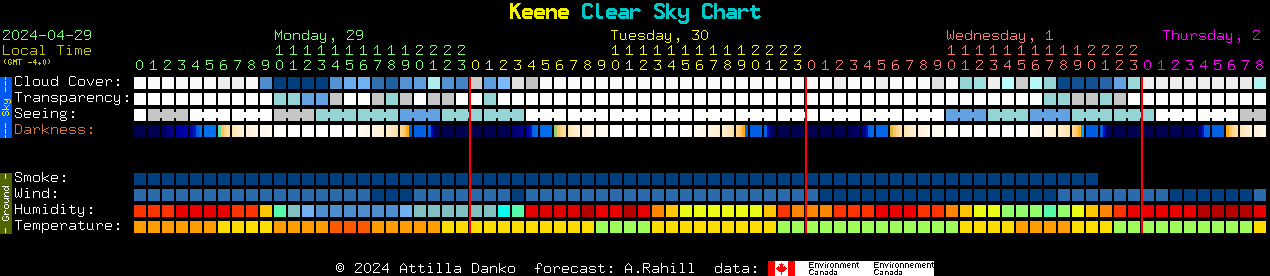
Clear Sky Chart

Keene, NH:

Click the image for a complete sky condition forecast.

Chart courtesy of ClearDarkSky.com

Sun and Moon
Click for Keene, New Hampshire Forecast
For a complete month-by-month
moon phase calendar, click here.
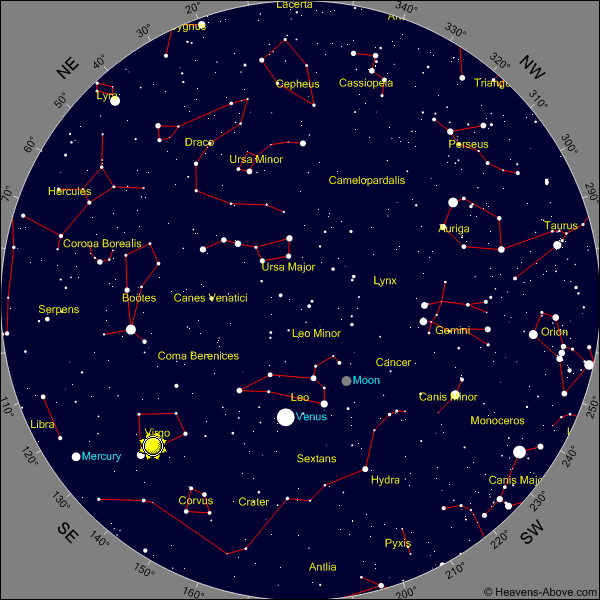
Tonight's Sky

Time

Keene, NH

UTC

Welcome - What We Do

The Keene Amateur Astronomers Club is a group of people whose goal is the enhancement of Amateur Astronomy by fellowship, sharing knowledge and enjoyment of the hobby. The KAA Club provides outreach programs when asked and holds monthly viewing sessions at our own observatory. Regular monthly club meetings are held at the Keene State college. Anyone interested is invited to attend.

Our membership is open to students, parents, beginners, backyard amateurs and also experienced professionals. And we provide opportunities for our members to grow in one of the greatest hobbies in this world or any other!

Founded in 1957, our club has a long and distinguished history. We are also members of the Astronomical League. And we actively participate in the annual Stellafane Convention which is consistently rated as one of America’s top Star Parties!

February 17th, 2012 Meeting

The February 2012 business meeting will take place on Friday, the 17th of February, at 7pm in the Keene State College Student Union. Weather and member interest permitting, observing will take place at the Sullivan Observatory after the meeting.

Also, weather permitting, observing will take place on Saturday, the 18th of February, at 7pm at our Sullivan Observatory.

All members and interested non-members are invited.

For directions, contact our Club Secretary, Bob Taylor, at 802.257.9358.

KAA Site of the Month

The current featured site is : Citizen Sky. Citizen Sky is a citizen science project providing you with a chance to do real scientific research. Citizen Sky welcomes everyone to be a citizen scientist. They will guide you through the process of how to observe objects in the universe, how to send them your observations, and then how to see your results, analyze them, and even publish them in a scientific journal!! No previous experience is required. They hope that this project will involve thousands of people all over the world in real, active scientific research.

This site serves as “home base” for participants. They launched in June, 2009 and the site includes blogs, discussion forums, places to submit and analyze data, training materials, and much more.

Here is a video introduction to the Citizen Sky Project by Rebecca Turner, the Citizen Sky Project Manager— outtakes included!

We will be featuring a different web site periodically for your interest. If you have a site you really like and think it has wide interest, please send it along to us.

Keene Public Library and Keene Amateur Astronomy Club Team Up To Offer Month Long Lecture Series

This February, the Keene Public Library and the Keene Amateur Astronomy Club will host a five-part Astronomy Lecture Series. Interested community members are invited to attend any or all of the lectures that will be held each Thursday in February in the library's auditorium. The series is planned in conjunction with the Keene Amateur Astronomy Club.

The series begins on Thursday February 2, 2012 at 7 p.m. with a presentation called "Astronomy: Myths and Misconceptions" This lecture presented by astronomer Matt Marulla will help you distinguish fact from fiction. Matt will discuss a variety of unusual astronomical beliefs, from the moon landing being faked to being able to balance an egg on its end during the spring equinox. He’ll set the record straight as to what's accurate astronomy and what's mere celestial superstition.

The series will continue on February 9th with the presentation "Astronomy: Big Eyes For the Earth". In this lecture by Al Boudreau of Frosty Lane Observatory, VT, you'll find out about the current and near-future work on giant telescopes that will open up the universe as never before.

On February 16th, the presentation will be "Can A Black Hole Make you Disappear?" Black holes are among the most mysterious objects known. What are they? Where can they be found? Where is the closest one to us and are we in danger of being swallowed up? Find out as professional astronomer Matt Marulla sheds light on these questions as he discusses the darkest places in the universe.

February 23rd will bring us "Alien World Update". Over 500 worlds have been detected and still counting. Scientists have now imaged a system with four planets around it and we know of two systems with five planets and one with six! Astronomer and science writer John Gianforte will take us on a spellbinding mission to find out about these alien worlds. His talk will provide a brief overview of how extra solar planets are found, focusing mainly on the two methods that have detected the most extra solar planets. In the course of his presentation, he'll share his own research on extra solar planets. Finally, Gianforte will share how anyone with a computer can now help astronomers find undiscovered planets!

The final presentation of the series "Colliding Galaxies and Monster Black Holes" is on March 1st. How did galaxies like our Milky Way form? Beautiful images of galaxies from telescopes often hide their violent pasts. Many galaxies grow by cannibalizing smaller galaxies or by crashing into each other in giant cosmic train wrecks. What's more, most galaxies (including our Milky Way) hide monster black holes in their centers, which sit quietly waiting to be fed. But when galaxies collide, these monsters awake…and they are anything but quiet. Astronomer Laura Blecha will tell us about the fate of galaxies and black holes in these collisions, including the ultimate fate of our own galaxy. Ms. Blecha is a Ph.D. candidate at the Harvard-Smithsonian Center for Astrophysics.

All presentations are free and open to the public. Lectures will start at 7 p.m. in the library's basement auditorium. The library is located at 60 Winter Street.
For more information about the lecture series, visit www.keenepubliclibrary.org or download a poster on the series. Many thanks to Gail Zachariah of the Keene Public Library for all her efforts make this happen. We hope to see you there.

Young Astronomy Photographer of the Year - 2011

This photo is the winner of the "Astronomy Photographer of the Year 2011" international competition. Congratulations to Jathin Premjith, age 15, India, who wins the title "Astronomy Photographer of the Year 2011" with this spectacular image of the total lunar eclipse. What the photographer says: ‘I was always fascinated by the coppery-red colour of the Moon during the total lunar eclipse. Also it was interesting to note that not all lunar eclipses are the same, as the colour can change from light red to dark red depending on the position of the Moon and the amount of dust or pollution in the atmosphere at that time.’

Jathin used a Celestron CPC800 203.3mm (8-inch) Schmidt-Cassegrain telescope and a Canon 5D Mark II DSLR camera.

What it shows:

A lunar eclipse is a brief alignment of the Sun, Earth and Moon which places the Moon in the Earth’s shadow. Here the Moon is a red colour because it is lit by sunlight which has been filtered through the Earth’s atmosphere. The photograph skilfully captures a second fleeting astronomical event, the moment a star appears from behind the orbiting Moon.

What the judges say:

Rebekah Higgitt says: ‘The judges are always hugely impressed by the quality of the Young Astronomer entries. For me, this is one of the most striking images in the competition. The colour of the eclipsed moon, reflecting the red of sunsets all over Earth, is both delicately beautiful and truly majestic. The photographer has also captured just the right moment, with a bright but tiny star close to occultation.’


The world-wide competition is organized and owned by the Board of Trustees of the National Maritime Museum (‘Royal Observatory Greenwich’). For all this year's winners, click The Astronomy Photographer of the Year 2011.

Viewing the ISS and Iridium Flares

To view the upcoming ISS paths and/or the Iridium flares, log into Heavens Above and input your observing site coordinates. For information on the international Space Station, click here and for information on the Iridium satellites, click here.

Never Leave Your Camera Home...


The above image of our moon was photographed by Jim Faux on September 25, 2009 at 6:42 pm in North Truro, MA as a jet was lifting off from Logan Airport. The image was taken with a handheld Canon D20. [1/20 sec, F5.6, ISO-200, 300MM]